The Dodecahedron: The Secret Sacred Shape
Most people have heard of a cube. Some might know a pyramid (that’s a tetrahedron), or even the 20-sided dice used in games (that’s an icosahedron). But there’s one special shape that’s more mysterious than the rest: the dodecahedron (pronounced DOH-deck-uh-hee-drun).
For thousands of years, it’s been linked to big ideas about the universe, and for a long time, some people thought it was too important to share with just anyone.
Five Special Shapes, One Big Mystery
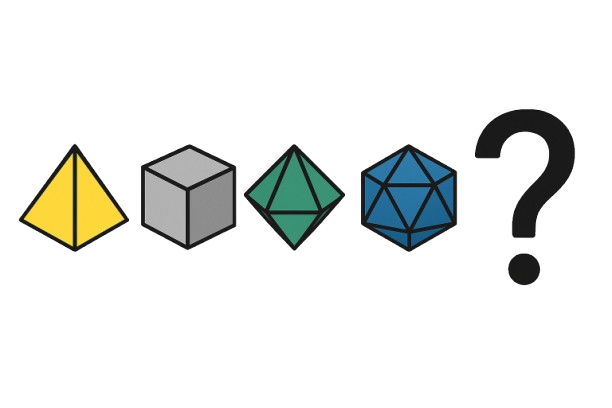
The ancient Greeks discovered five “perfect” 3D shapes, called the Platonic solids. Each one has the same kind of face, angle, and corner all the way around.
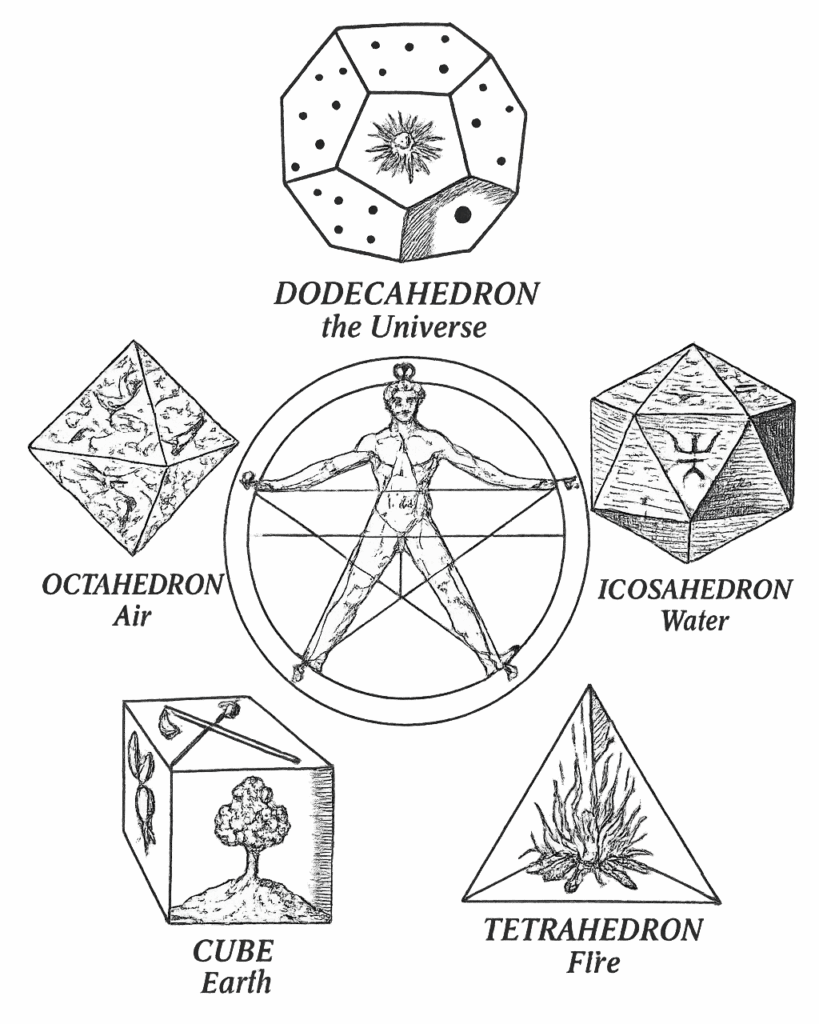
Plato, a famous Greek thinker, connected four of them to the “elements” people believed made up the world:
Tetrahedron → fire
Cube → earth
Octahedron → air
Icosahedron → water
The fifth one—the dodecahedron—was different. Plato said the gods “used it for the whole universe”… and then didn’t explain. That one mysterious sentence left people wondering for centuries.
Why Keep It Secret?
The Pythagoreans, a group of ancient mathematicians and philosophers, treated math almost like a secret club. Some shapes and discoveries were for members only.
The dodecahedron’s 12 pentagon-shaped faces made people think of the zodiac, the months of the year, and even a “fifth element” beyond earth, air, fire, and water. It became a symbol of the entire cosmos.
Some legends say that showing how to make a perfect dodecahedron inside a sphere was a guarded secret—something you could get in big trouble for revealing.
A Story of Forbidden Knowledge
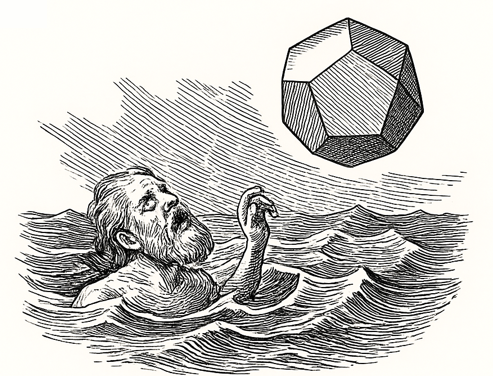
In fact, about 800 years after Plato, the philosopher Proclus told a story about a man named Hippasus. He was a Pythagorean who, according to the tale, was drowned at sea for revealing a mathematical secret.
Some versions say the secret was about irrational numbers. Others say it was how to build the dodecahedron. Either way, the story’s message was the same: some knowledge was considered too important (or too sacred) to share freely.
Was Hippasus really murdered? Or was this just a story about breaking the trust of the group? We may never know—but the tale gave the dodecahedron a dangerous, exciting reputation.
Echoes Through History
- Roman Gaul: Archaeologists have found strange bronze dodecahedra from the 2nd–3rd centuries CE. We still don’t know exactly what they were for—measuring devices? Ritual objects? Gaming pieces?—but they’ve become part of the dodecahedron’s mystique.
The Renaissance: Kepler used the Platonic solids (including the dodecahedron) in his early attempts to model the solar system. Even though the model didn’t hold up, the symbolism of the dodecahedron as a cosmic key persisted.
Modern esoterica: From New Age geometry to tabletop gaming dice, the dodecahedron’s “whole universe” connection keeps it in circulation.
Why It Still Feels Sacred
Even if you strip away the myths, there’s something remarkable about the dodecahedron. It’s the most complex Platonic solid, its faces pentagons—shapes that themselves have deep mathematical ties to the golden ratio. Hold one in your hands and it’s easy to see why ancient thinkers might have seen it as a miniature cosmos.
Whether or not it was ever truly secret, it has always been special.
Join Us in Exploring Math Beyond the Classroom
If the story of the dodecahedron sparks your curiosity—if you love uncovering the hidden corners of mathematics and exploring ideas they don’t have time to teach you in a standard class—then You Discover Math is for you.
As a student or volunteer with YDM, you’ll get to dive into fascinating topics, tackle hands-on projects, and share the joy of discovery with others who are just as passionate about learning. Whether you’re here to explore, to teach, or to help bring math to new communities, you’ll be part of a welcoming group that celebrates curiosity and creativity.
Don’t just learn math—discover it!
And if you want to build your own dodecahedron, check out this video tutorial… just please don’t tell the Pythagoreans we told you! They kept secrets; we’re the opposite. Our mission is to make math open, welcoming, and for everyone. Because the more people who can explore its wonders, the better!
© 2026 All Rights Reserved.

 Spanish
  English